
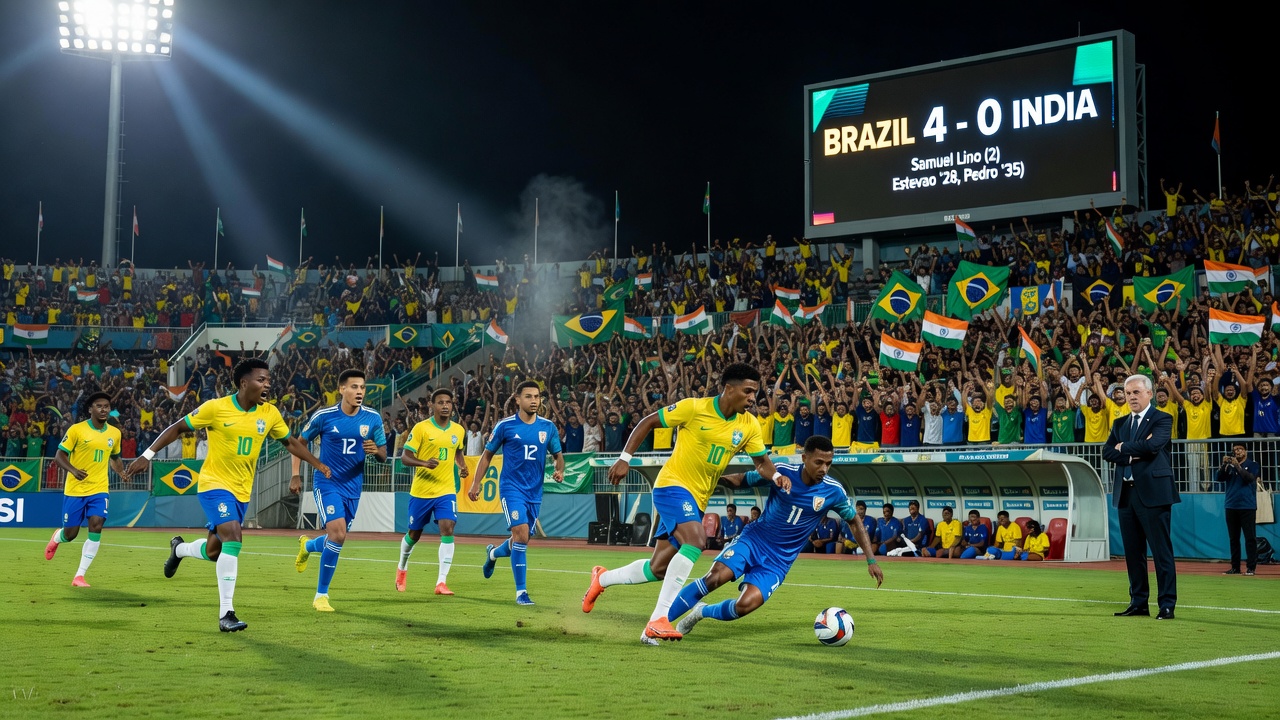
Brazil's squad rotation experiment produced another emphatic result on Saturday, as a second-string selection brushed aside India 4-0 at Salt Lake Stadium in Kolkata. Samuel Lino scored twice, Estevao and Pedro added the others, and a crowd of 51,000 watched the five-time world champions close out a short tour of Australia and India unbeaten.
A Youthful Side Still Delivers
Carlo Ancelotti made eight changes from the team that beat Australia 4-2 three days earlier, keeping only Vinicius Jr, Danilo and Gabriel Bontempo from that lineup. The approach reflects a broader pattern among elite national teams during international windows: use exhibition fixtures to assess squad depth rather than chase a dominant scoreline. Even with a reshuffled XI, Brazil's technical gap over India proved decisive. Estevao, the Chelsea winger, opened the scoring in the 28th minute with a near-post finish before setting up Pedro for the second. Lino, a 26-year-old Flamengo forward, added two more in the second half, including a solo run past two defenders.
India's Tactical Plan Had Early Promise
For a half, India's setup worked. Coaches often instruct lower-ranked sides to sit deep, compress midfield space, and use the offside trap against a dangerous attacking outlet - in this case Vinicius Jr, left isolated on the left flank. India combined that defensive discipline with long balls toward lone striker Manvir Singh, a pragmatic approach against superior opposition. It delayed Brazil's breakthrough but could not prevent it once Estevao found room to cut inside.
A Results Gap That Reflects the Rankings
India sit 138th in the FIFA world rankings, a gulf that this scoreline reinforces rather than reveals anything new. The defeat extends the team's winless run to six matches, with Manvir Singh and Ryan Williams both missing chances that might have produced a consolation goal. For a federation trying to build momentum domestically, friendlies against top-tier opposition serve a dual purpose: they test players against elite talent while also exposing gaps in finishing and game management under pressure. The reception from the home crowd - cheering Brazil as loudly as their own team - speaks to the global draw of the Brazilian shirt, even a much-changed one, and the commercial logic behind scheduling such tours in emerging footballing markets.
Why These Tours Matter Beyond the Scoreline
International friendlies in markets like India are rarely just sporting exercises. They function as commercial and developmental tools: broadcasters secure high-profile content, sponsors gain visibility in a cricket-dominated market, and host federations use ticket sales and exposure to justify continued investment in facilities and player pathways. For Brazil, the trip also let Ancelotti evaluate fringe players such as Estevao and Lino in competitive conditions before tougher assignments arise. The result itself changes little about either team's trajectory, but the exercise underscores how modern international football increasingly blends sporting assessment with global market-building.