
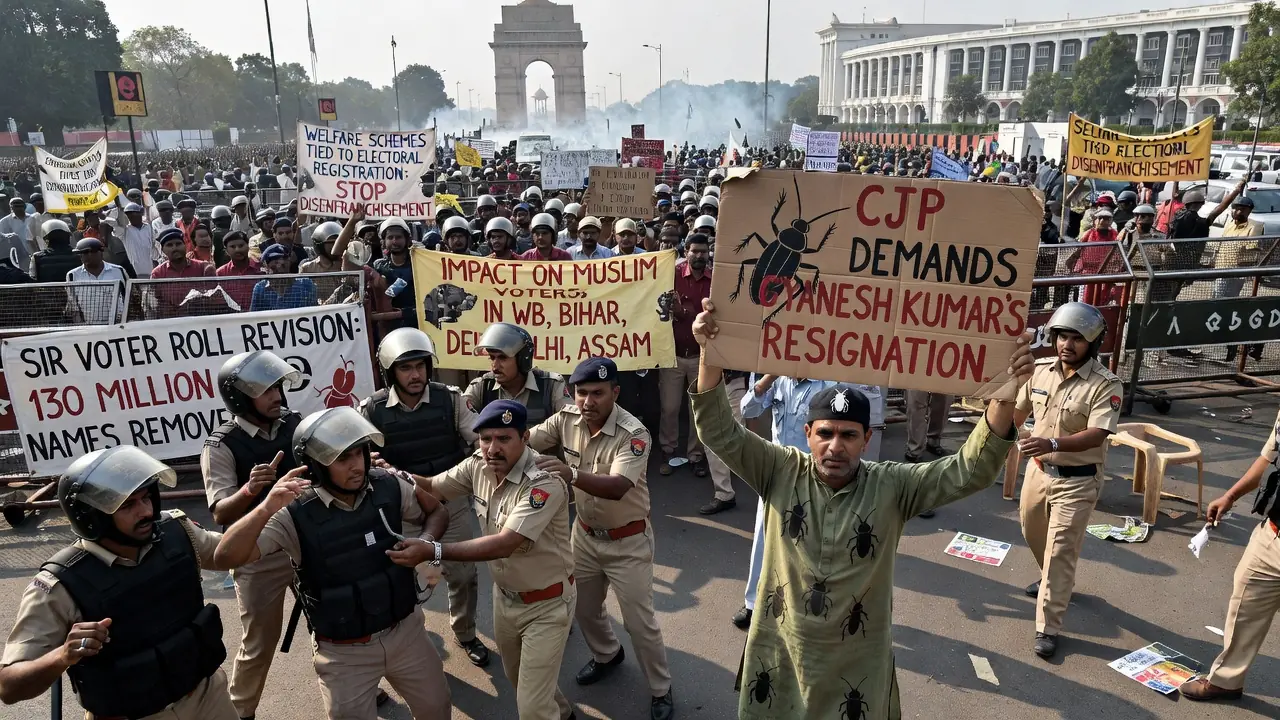
Delhi police detained hundreds of demonstrators, including the founder of the satirical Cockroach Janta Party (CJP), Abhijeet Dipke, to prevent a rally demanding the resignation of India's chief election commissioner. Thousands of security personnel were deployed, travel routes restricted, and telecommunications links suspended across parts of the capital, turning what organisers framed as a peaceful assembly into a citywide lockdown.
What the dispute over voter rolls is really about
At the centre of the unrest is the Special Intensive Revision (SIR), a nationwide exercise requiring voters to re-prove their eligibility using old documents such as birth certificates, land records, or education papers. Critics argue this places a disproportionate burden on poorer, migrant, and marginalised citizens, who are less likely to hold such paperwork in a country where record-keeping has historically been inconsistent. A clerical mismatch in decades-old files can be enough to strike a name from the rolls.
In India, voting rights are not merely symbolic. Access to several welfare schemes is linked to electoral registration, meaning removal from the voter list can carry economic consequences far beyond the ballot box. Opposition parties say the deletions have disproportionately affected Muslim voters in states such as West Bengal, Bihar, Delhi, and Assam - communities that do not typically support the governing Bharatiya Janata Party (BJP). More than 130 million people have reportedly been removed from the rolls under the exercise, a scale that has intensified scrutiny of the Election Commission's independence and procedures.
From satire to street movement
The CJP began in May as an online satirical response to a remark by India's Chief Justice comparing unemployed youth and activists to "cockroaches." The label was reclaimed as a badge of protest identity. Its first campaign, targeting the education minister over exam system failures, escalated from a small gathering in June to a 10,000-strong march in July that ended in clashes with police using tear gas and batons. The minister resigned days later, giving the movement an early, tangible result.
That success appears to have shaped its second campaign, launched in October and aimed squarely at Chief Election Commissioner Gyanesh Kumar. Daily protests spread to Bengaluru and Mumbai before culminating in the attempted national rally in Delhi, where CJP leaders were detained on arrival alongside hundreds of others, including student union figures and senior opposition politicians.
Institutional credibility under strain
The controversy extends beyond street politics. A former chief election commissioner has publicly described the institution as having lost public trust, calling its current state "dysfunctional." The Election Commission maintains that the revision is a legitimate, overdue effort to remove duplicate or fraudulent entries from the rolls. Opposition parties dispute this framing and have taken the matter to the Supreme Court, arguing that the exercise lacks transparency and has materially affected recent state election outcomes.
This is, at its core, a governance and accountability question: who verifies the verifier? Electoral commissions in democracies depend on perceived neutrality to function. When that perception erodes, the legitimacy of election outcomes themselves comes into question, regardless of the technical accuracy of any single roll revision.
Detentions, press access, and the right to protest
Human rights organisations, including Amnesty International, have criticised the scale of detentions, which reportedly exceeded 5,000 people and included journalists, lawyers, and opposition figures. Press freedom groups have separately raised concerns about journalists being detained and equipment confiscated while covering the protests, arguing this undermines independent reporting on matters of clear public interest.
The government has dismissed the demonstrators as a fringe element with no bearing on the country's broader stability. Independent analysts see it differently, suggesting the protests reflect a genuine test of political authority at a moment of perceived vulnerability for the ruling party. Whichever reading proves accurate, the episode underscores a recurring tension in large democracies: balancing public order with the constitutional right to peaceful assembly and scrutiny of electoral institutions.