
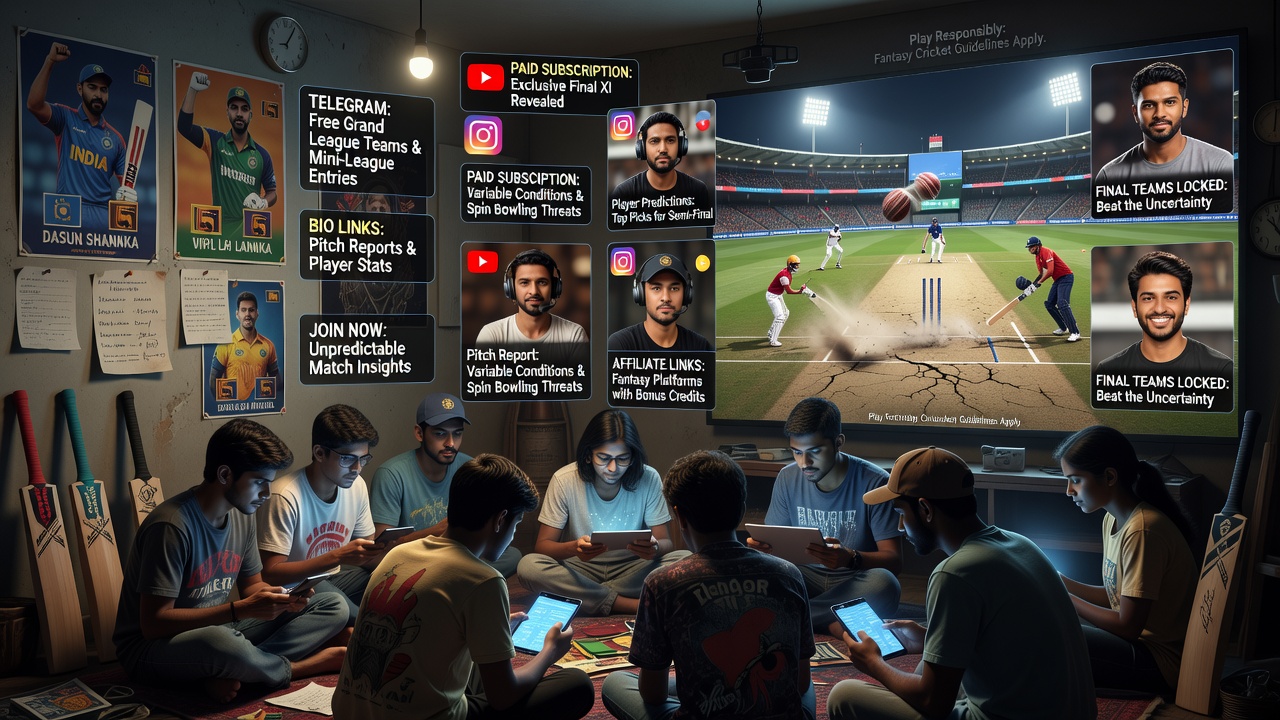
A short promotional video circulating ahead of the India-Sri Lanka second semi-final illustrates how fantasy sports content creators have built an entire micro-economy around high-profile cricket fixtures. The clip promises a "free" grand league team and mini-league entries, directing viewers to a Telegram channel through a bio link - a pattern now common across fantasy cricket communities in India and South Asia.
How the fantasy sports content economy works
Fantasy cricket platforms allow users to assemble virtual teams based on real players, earning points according to actual match performance. Around these platforms has grown a parallel layer of creators - YouTubers, Telegram channel operators, Instagram influencers - who publish team predictions, lineup analysis, and pitch reports before big matches. Their business model depends on audience volume: more subscribers and views translate into advertising revenue, affiliate commissions, or paid subscriptions for "premium" team suggestions. Encouraging viewers to join a Telegram group, as in this case, is a standard growth tactic, converting casual viewers into a retained audience that can be monetized repeatedly.
Why "free" team advice deserves scrutiny
Presenting a team as a shortcut to success in a grand league or mini-league obscures a basic mechanical reality: fantasy sports outcomes depend on unpredictable player performance, pitch conditions, and chance events during live play. No creator, regardless of follower count or past results, can reliably forecast outcomes. Framing predictions as a route to a "final team" risks implying a level of certainty that does not exist in any skill-based or chance-influenced contest involving real money entry fees. This matters because many fantasy platforms operate within a regulatory grey zone across Indian states, where some jurisdictions classify these contests as games of skill while others restrict or ban paid participation entirely.
Platform incentives and audience risk
Telegram and similar messaging apps have become preferred distribution channels for this content precisely because they sit outside the content-moderation systems that govern mainstream social platforms. Groups can scale quickly, share links to fantasy apps, and push repeated calls to action with minimal oversight. For younger or inexperienced users, the psychological effect of watching an influencer confidently predict a "final team" can normalize frequent play and higher entry stakes, even though these predictions carry no guarantee of returns. Responsible platforms typically require age verification, deposit limits, and clear disclaimers about the financial risk involved in paid fantasy contests - safeguards that informal Telegram-based advice networks rarely replicate.
What this signals for regulators and advertisers
The growth of creator-led fantasy sports promotion ahead of major tournaments adds pressure on regulators already examining how online gaming and fantasy sports advertising is disclosed and monitored. Advertising standards bodies in several markets have begun requiring clearer labeling of sponsored gaming content, and fantasy platforms themselves face increasing compliance expectations around responsible-gaming messaging. As cricket tournaments continue to drive spikes in fantasy sports engagement, the gap between informal social-media promotion and formal consumer-protection standards remains one of the sector's more pressing unresolved issues.