
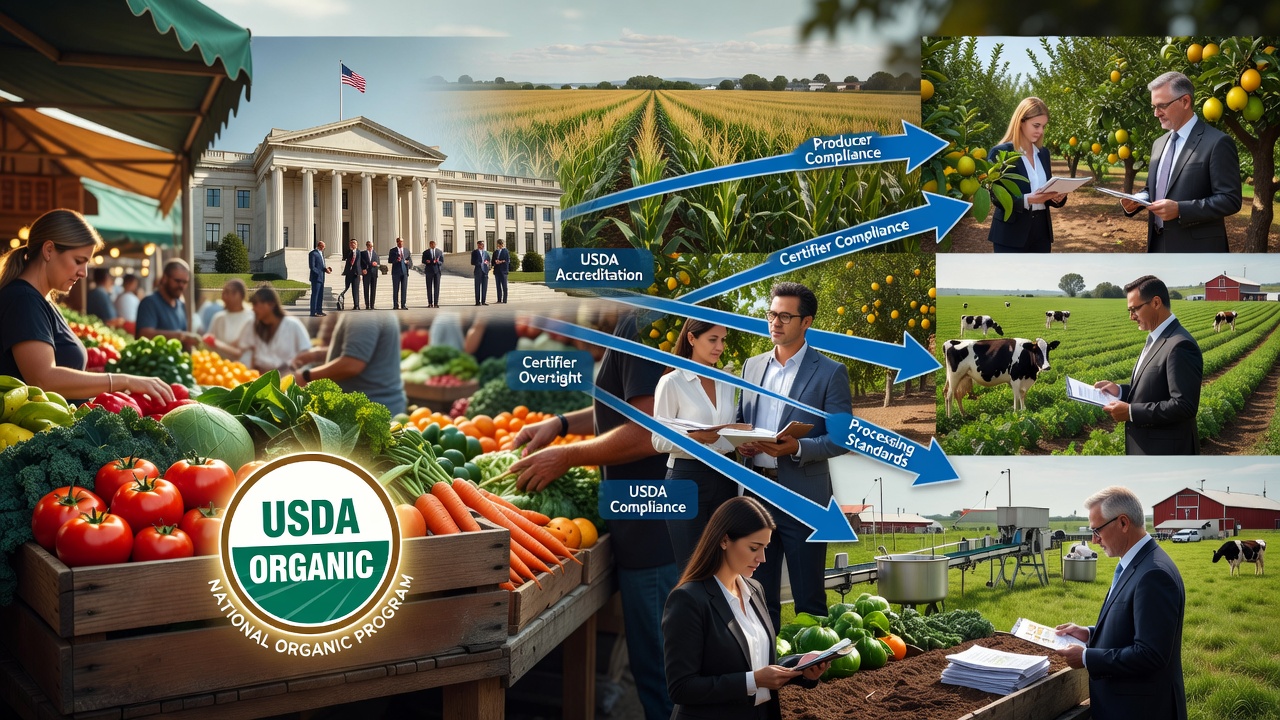
Every product carrying the USDA Organic Seal rests on a regulatory structure most shoppers never see. The National Organic Program, known as NOP, is the federal mechanism that defines what "organic" legally means for agricultural goods sold across the United States, and it enforces that definition through a layered system of oversight rather than a single inspection body.
What the Program Actually Regulates
NOP does not certify farms directly. Instead, it sets the national standards that govern organic production and handling, then delegates certification work to accredited third-party organizations. These certifying agents, which can be private companies or state-run bodies, evaluate whether a farm or processing operation actually follows the rules before that operation can label anything organic. This structure allows the program to operate at national scale without USDA staff inspecting every farm itself.
Why Third-Party Accreditation Matters
The accreditation layer is the part of the system most consumers overlook, yet it is central to the program's credibility. USDA accredits the certifiers, and the certifiers in turn audit producers, creating a chain of accountability. If a certifier fails to apply the standards correctly, USDA has grounds to review or revoke that certifier's accreditation. This dual-level enforcement is designed to prevent a single point of failure from undermining trust in the seal nationwide.
The Market Logic Behind Consistent Standards
Before a unified federal standard existed, organic labeling in the United States was fragmented, with different states and private groups applying their own definitions. That inconsistency created confusion for buyers and uneven competitive conditions for producers, since a claim considered organic in one region might not meet the bar elsewhere. A single national standard removes that ambiguity, giving producers a common set of rules to compete under and giving buyers a label they can interpret the same way regardless of where a product was grown or processed.
Where the Real Risk Sits
The integrity of the entire system depends on enforcement quality, not just the existence of a rulebook. Compliance failures, mislabeling, or lax auditing by an accredited certifier can quietly erode consumer confidence even when the underlying standards are sound. This is why ongoing oversight of certifiers, rather than the initial standard-setting, is often the more consequential part of the program's work. For businesses operating in the organic supply chain, that oversight translates into real compliance obligations: recordkeeping, recurring audits, and the possibility of decertification if standards slip.
- NOP sets national standards for organic agricultural products.
- USDA accredits independent certifying agents rather than certifying farms directly.
- Certifiers audit producers against the federal standards on an ongoing basis.
- The system's credibility depends on consistent enforcement across all accredited certifiers.