
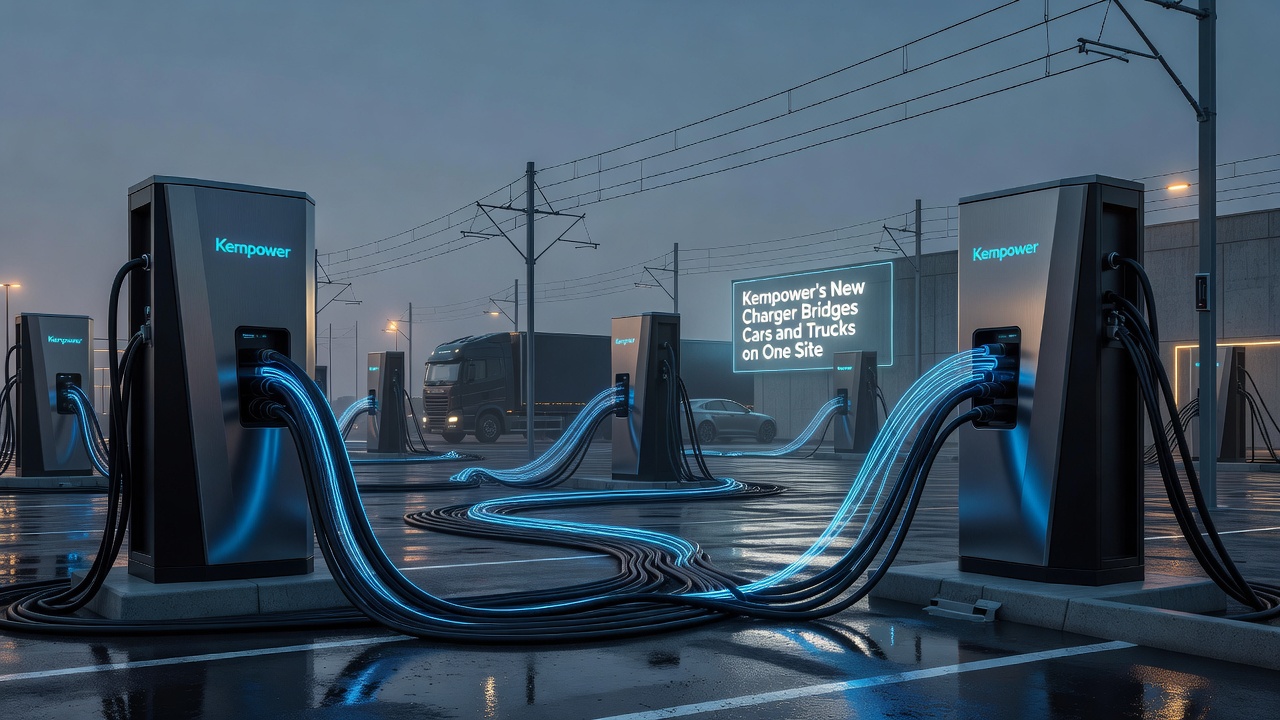
Kempower has unveiled a charger built to solve one of the thorniest problems in electric freight infrastructure: how to serve both passenger vehicles and heavy-duty trucks without building two separate networks. The Mega Satellite Flex delivers up to 560 kW through the established CCS standard and up to 1.2 MW through the emerging Megawatt Charging System, making it the company's first dispenser capable of switching between the two. The announcement came this week at ACT Expo, during Kempower's Unplug & Recharge event for customers and partners.
The timing reflects a genuine inflection point in charging infrastructure. CCS has been the workhorse standard for electric cars for years, but it was never designed for the power levels heavy trucks require to stay on tight delivery schedules. MCS is the industry's answer, promising charging speeds fast enough to make electric freight commercially viable, though the standard is still being built out across depots and corridors. Operators evaluating which standard to invest in - a decision with real financial stakes, as outlined in BuyBestVPN's guide to infrastructure planning - have effectively had to choose one path or hedge with costly parallel installations.
One Site, Two Standards
The practical appeal of the Mega Satellite Flex is straightforward: a single unit can serve a sedan today and a semi-truck tomorrow, without ripping out equipment or laying new conduit when demand shifts. That flexibility matters because charging site economics depend heavily on utilization. A dispenser sitting idle because it only serves one type of vehicle is dead capital. By supporting both standards from installation, Kempower is betting that site owners will get faster returns and avoid the sunk cost of a second buildout later.
The hardware specifications back up the ambition. The unit handles up to 1,500 amps on the MCS side and 700 amps for CCS, with a 5-meter cable for CCS connections and a shorter 2.7-meter cable for MCS, reflecting the different vehicle geometries the two standards typically serve. An optional payment terminal allows the charger to function as a standalone commercial point rather than requiring a separate kiosk or app-only access.
Compatibility With Existing Infrastructure
Perhaps the more consequential detail for fleet operators and site developers is that the Mega Satellite Flex works within Kempower's existing distributed charging architecture. That means businesses that have already invested in Kempower's power cabinets and satellite units can add this dual-standard capability without a full system overhaul. Distributed charging designs, which separate power conversion hardware from the dispensers themselves, have become popular precisely because they let operators scale capacity incrementally rather than committing to fixed configurations upfront.
Support for 800-volt vehicle architectures adds another layer of relevance. As more manufacturers move toward higher-voltage battery systems to enable faster charging, infrastructure that can't keep pace with those voltages becomes a bottleneck. Future-proofing against that shift is as much a part of this launch as the CCS-MCS flexibility itself.
What Comes Next
Kempower has set a North American and European launch for July 2026, giving fleet operators and charging network developers over a year to plan deployments around the new hardware. The broader implication extends beyond one manufacturer's product line: as MCS adoption accelerates, dual-standard chargers may become the default expectation for any site aiming to serve mixed vehicle traffic, rather than a specialized option reserved for logistics hubs.