
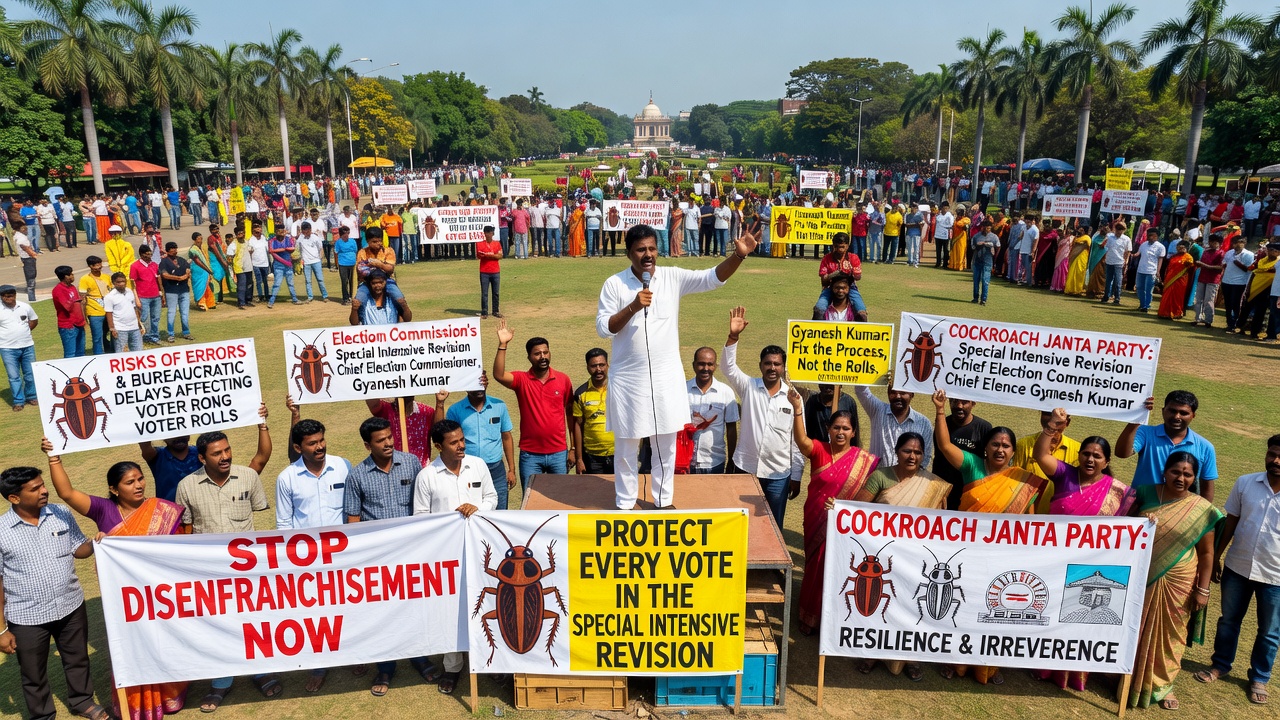
A political satire outfit calling itself the Cockroach Janta Party says a demonstration at Mumbai's Shivaji Park against the Election Commission's Special Intensive Revision drew a crowd large enough to prove the issue has genuine public traction. Party spokesperson Saurav Das told India Today the ground was "full" and "overflowing with people," and said the group now intends to carry similar protests to Karnataka, Uttar Pradesh and West Bengal before regrouping in Delhi.
What the Revision Process Involves
The Special Intensive Revision, overseen by Chief Election Commissioner Gyanesh Kumar, is a nationwide exercise meant to verify and update electoral rolls, a routine but consequential administrative function. Any large-scale revision of voter lists carries stakes for ordinary citizens: errors, omissions or bureaucratic delays can affect whether someone is able to cast a ballot at all. Civil society groups and opposition-aligned voices have used the SIR process as a rallying point, arguing that the scale and pace of the revision risks disenfranchising vulnerable or less-documented voters.
A Satirical Party With a Serious Message
The Cockroach Janta Party positions itself as a protest vehicle rather than a conventional political outfit, using irreverence to draw attention to issues around transparency and voting rights. Das framed the Mumbai turnout as evidence that concerns about the revision process extend well beyond a narrow activist base. He also criticised restrictions placed on protest venues, a recurring friction point in Indian civic life where permissions for public assembly are tightly controlled by local authorities and police.
Delhi's Crackdown and the Commission's Response
The contrast with Delhi is notable. There, comparable demonstrations against the same SIR process led to more than 1,000 detentions, a scale of enforcement that underscores how differently authorities in different cities have handled similar protests. The disparity raises questions about consistency in how the right to peaceful assembly is treated across jurisdictions, particularly when the underlying grievance concerns access to the ballot itself.
Separately, the Election Commission has announced a special voter enrolment drive, a move that appears aimed at addressing some of the concerns raised by protesters even as it continues the broader revision. Whether the enrolment push will ease tensions or simply shift the debate toward implementation details remains to be seen. For now, Das has signalled the party intends to keep the issue visible through further demonstrations rather than treat the Mumbai protest as a one-off event.