
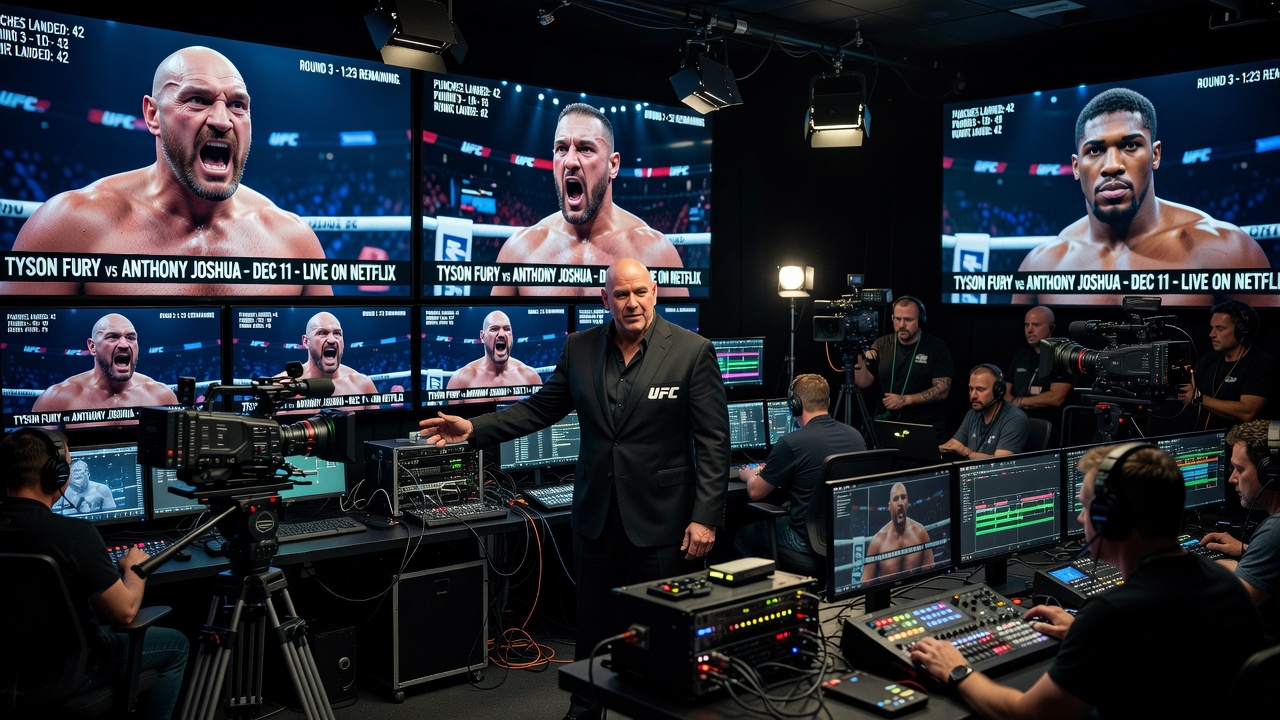
Dana White skipped the London press conference announcing Tyson Fury's heavyweight fight against Anthony Joshua, but he insists his absence from the stage means nothing about his involvement behind the scenes. The UFC CEO confirmed his organization will produce the broadcast of the Dec. 11 Netflix event from Cardiff, even as promoter Eddie Hearn publicly declared the UFC's entry into boxing a failed experiment.
A Dispute Over Optics, Not Operations
The public back-and-forth between White and Hearn centers less on who holds promotional rights and more on perception. Hearn, who promotes Joshua, used White's absence from the press conference to argue that the UFC chief had overstated his role in the fight. White countered by pointing to a concrete operational fact: UFC's production team will handle the broadcast itself, a function distinct from - and arguably more consequential than - appearing at a media event. In combat sports, production control often determines how revenue is split and how the event is packaged for a streaming audience, which matters more to the bottom line than who sits at the dais.
This distinction matters for anyone trying to understand how modern boxing promotions actually work. Press conferences generate headlines, but production deals determine who controls the underlying product - camera feeds, commentary, graphics packages, and ultimately the footage that reaches viewers. White's company, through its Zuffa Boxing venture, appears to have secured that production role regardless of who fronts the promotional messaging in the UK.
Why Netflix and Saudi Backing Change the Calculus
The involvement of Turki Alalshikh, a Saudi-backed figure who has become a major financial force in global boxing, signals how the sport's economics have shifted. Large-scale events increasingly depend on sovereign wealth investment and streaming platforms rather than traditional pay-per-view models. Netflix's decision to air the Fury-Joshua fight reflects a broader trend of streaming services using marquee combat sports events to draw subscribers, a strategy already tested with other high-profile boxing cards.
For UFC, which White has built into the dominant force in mixed martial arts, extending into boxing production represents a business diversification rather than a straightforward promotional rivalry with Hearn's Matchroom Boxing. The friction between the two executives reflects competing claims to credit and control in an increasingly crowded combat sports marketplace, where multiple stakeholders - promoters, broadcasters, financial backers, and production companies - all have overlapping interests in a single event's success.
What This Means for Fans and the Industry
For viewers, the practical outcome is straightforward: the fight will stream on Netflix on Dec. 11, regardless of which executive wins the public argument. But the dispute illustrates a less visible reality of modern sports entertainment - that promotional credit and operational control are often separate, sometimes contested, commercial arrangements. Consumers watching combat sports increasingly interact with content shaped by multiple corporate entities whose commercial relationships are not always transparent at the point of broadcast.
- UFC confirmed as the event's broadcast producer, separate from promotional duties held by Hearn and Frank Warren.
- Saudi-linked investment, represented by Turki Alalshikh, continues to play a significant financial role in major boxing cards.
- Netflix's involvement reflects streaming platforms' growing appetite for live combat sports as subscriber-driving content.