
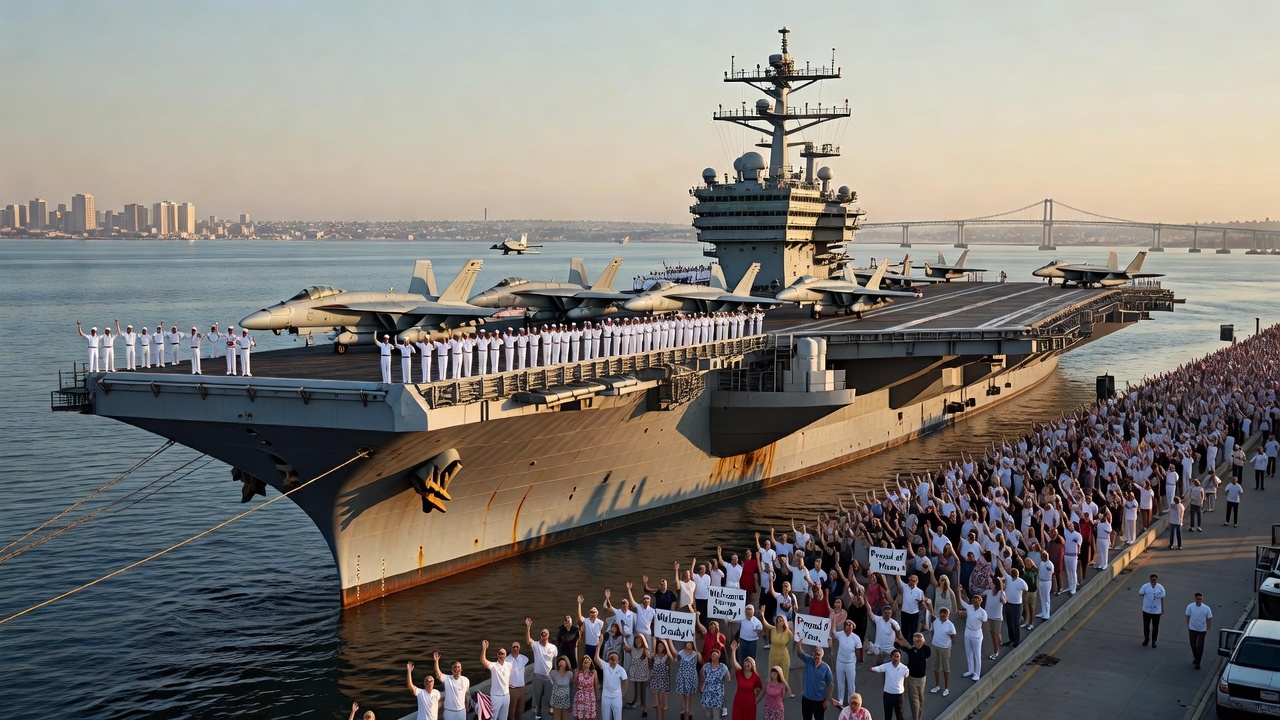
The USS Abraham Lincoln is back in San Diego after nearly ten months at sea, closing out one of the longest and most intense carrier deployments in recent memory. The carrier strike group spent more than 260 consecutive days without a single port call, a stretch the Pentagon says coincided with sustained U.S. military operations against Iran. For the thousands of sailors aboard, the homecoming marks the end of a deployment defined less by routine patrol duty and more by extended combat tempo.
A Deployment Stretched by Conflict
Defense Secretary Pete Hegseth has described the scale of what the strike group carried out: thousands of combat sorties and hundreds of Tomahawk missile launches over the course of the deployment. Carrier deployments are typically planned around six to seven months, with port calls built in to allow crews rest, resupply and limited contact with the outside world. The Abraham Lincoln's deployment broke from that pattern entirely. More than 260 straight days underway, without the chance to step onto dry land, reflects the operational demands placed on naval forces when a regional conflict escalates faster than rotation schedules can absorb.
The Human Cost of Extended Operations
Long deployments carry a toll that goes beyond logistics. The Navy reported eight suicide attempts among sailors in the carrier strike group during this deployment, a figure that puts a human face on what "extended and demanding" actually means for the people involved. Confinement to a warship for months without a break, combined with the psychological weight of active combat operations and prolonged separation from family, creates conditions that military mental health specialists have long flagged as high-risk. The Navy has invested in shipboard mental health resources and peer support programs in recent years, but incidents like these raise renewed questions about whether current staffing and support structures are adequate when deployments run well beyond their planned length.
Why Deployment Length Matters Beyond the Ship
Extended carrier deployments ripple outward. Families at home face longer uncertainty. Maintenance cycles for the ship and its aircraft get compressed into shorter turnaround windows once the carrier returns, affecting how soon it can deploy again. And the broader U.S.-Iran standoff that drove this deployment continues to shape regional security calculations and global energy markets, where tanker traffic and oil prices remain sensitive to signs of military escalation in the Gulf. The Abraham Lincoln's return does not signal the end of that tension, only a rotation of forces.
What Comes Next for the Strike Group
Sailors returning to San Diego now face a period of reintegration with families and communities after nearly a year away. For the Navy, the deployment will likely feed into internal reviews of how combat tempo, crew welfare and mental health support interact during operations that extend far past standard planning assumptions. With tensions involving Iran still unresolved, the readiness of relief carrier strike groups, and the support systems available to their crews, will remain a point of scrutiny for defense planners and lawmakers alike.