
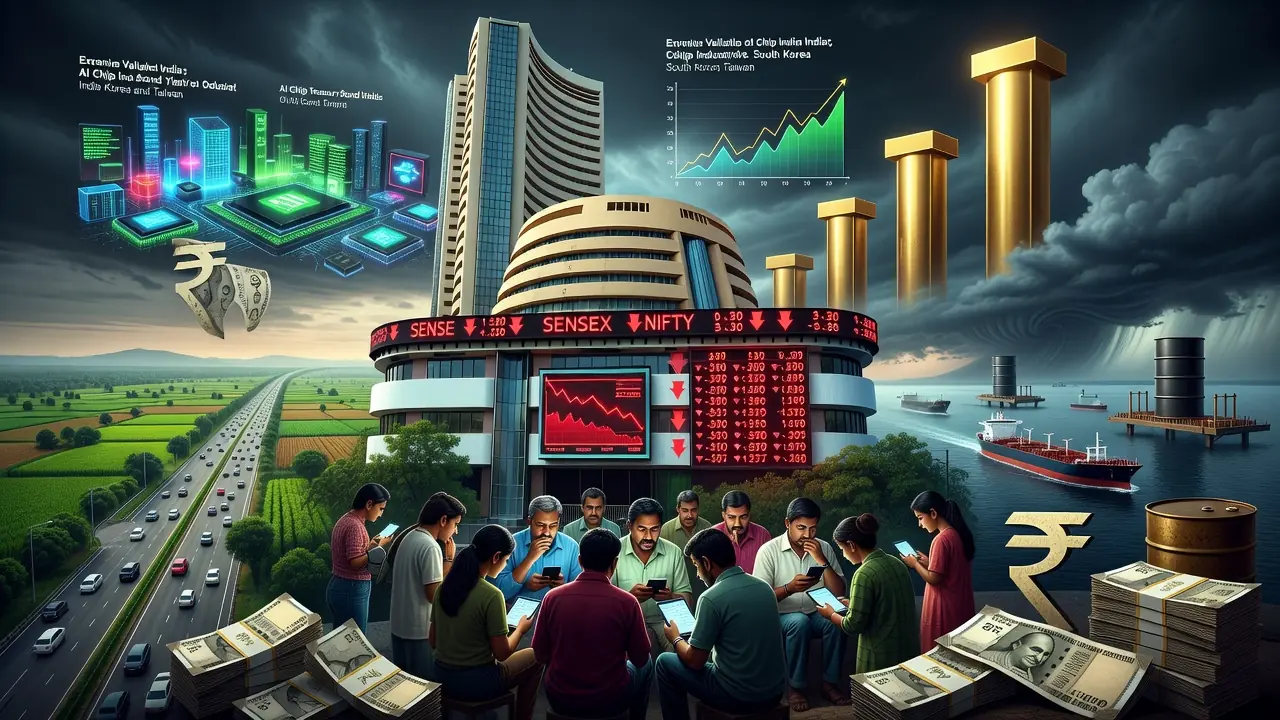
An economy expanding at over 7% a year is usually a magnet for investors. Yet India's benchmark indices, the Sensex and Nifty, have just posted their longest losing streak in a quarter century, according to Reuters. The disconnect between a strong economy and a weak stock market has left both foreign funds and millions of domestic retail investors nursing losses, and it raises uncomfortable questions about what equity markets are actually pricing in.
Energy and interest rates squeeze sentiment
Much of the pressure traces back to forces outside India's control. Prolonged disruption to shipping through the Strait of Hormuz has kept crude oil elevated, and India imports the vast majority of its oil needs, with a large share passing through that same corridor. Fund managers note that markets can tolerate oil in a moderate range, but once prices push past the higher end, inflation and corporate margins both come under strain. Layered on top of this is a global rise in interest rates, with US government bond yields sitting at multi-decade highs. When safe, dollar-denominated assets offer strong returns, capital that once flowed into emerging markets like India tends to retreat toward that safety, regardless of how fast those emerging economies are growing.
A weaker rupee and a valuation reset
Currency movement has compounded the problem for overseas investors. Returns that look reasonable in rupee terms shrink once converted back into dollars, because the rupee has weakened over the period. This has made Indian equities look far less rewarding to foreign portfolio managers than headline index numbers might suggest. At the same time, a multi-year correction has stripped away much of the valuation premium Indian stocks once commanded over other emerging markets. Shares are cheaper than their recent historical average, yet they remain relatively expensive against actual earnings, particularly when compared with markets like South Korea and Taiwan, where corporate profits have been lifted by the global boom in artificial intelligence infrastructure and chipmaking.
The missing new-economy engine
That AI-driven profit boom is largely absent from India's market story. Many of the country's largest listed companies belong to established, older-economy sectors, and analysts have pointed out that a number of them are focused more on protecting existing market positions than investing aggressively in new technology. India has not yet produced a globally dominant AI company comparable to those emerging from the US or China, and that gap matters, because a growing share of global equity value creation is concentrated precisely in that space. Promising activity is building in areas such as semiconductors, defence and deep-tech research, but these segments remain too small to shift overall capital allocation decisions at scale.
Retail investors carry the weight
What has kept the market from falling further is the steady inflow of domestic money. Mutual fund assets under management in India have grown enormously over the past decade, and the number of individuals investing in stocks and funds has expanded sharply. This retail base has continued contributing to monthly investment plans even as paper losses accumulate, a sign of confidence but also a source of real exposure for ordinary households already contending with a soft job market and persistent inflation. For a system increasingly reliant on retail participation rather than institutional or foreign capital, the key question going forward is whether that patience holds if the correction deepens, and whether product design, disclosure and investor education keep pace with the growing number of first-time market participants entering through mutual fund platforms.