
India's New Law Bans Real-Money Online Gaming Nationwide
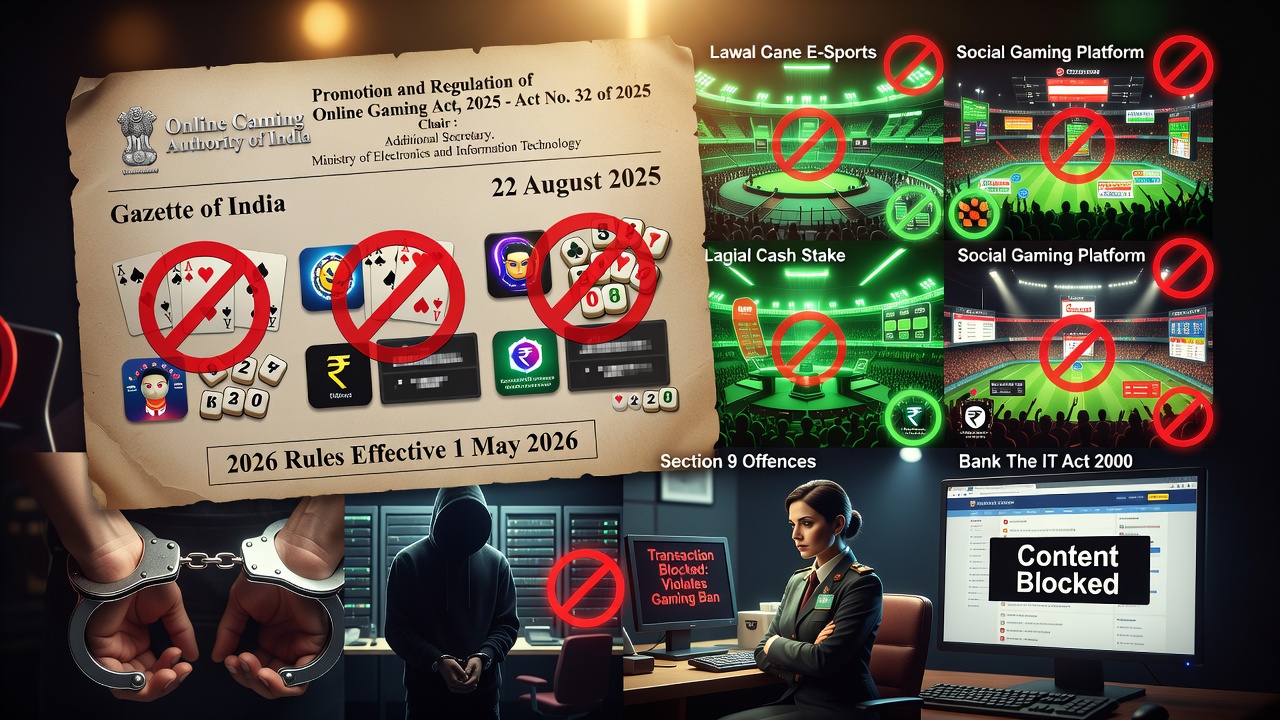
India has drawn a hard line between skill-based entertainment and gambling for cash, and the distinction that once shielded rummy, poker and fantasy sports operators from prosecution no longer exists. The Promotion and Regulation of Online Gaming Act, 2025 - Act No. 32 of 2025, published in the Gazette of India on 22 August 2025 - prohibits online money games outright while carving out support for e-sports and social gaming. The law's reach extends beyond Indian borders: any online money gaming service offered within India, or operated from abroad but accessible to Indian users, falls under its jurisdiction.
Why "Game of Skill" No Longer Matters
For years, Indian operators of rummy platforms, poker rooms and fantasy sports contests relied on a legal distinction between games of skill and games of chance, arguing that skill-based formats sat outside the definition of gambling. The 2025 Act closes that loophole by statute. Section 2 defines an online money game as any online game - skill, chance or a mix of both - played by staking money or value in expectation of winning more. Once a fee or deposit is involved, the skill argument becomes irrelevant. E-sports are explicitly excluded from this definition, which is why competitive gaming retains a path to legal operation while cash-stake games do not.
Three Offences, Escalating Penalties
The Act does not target players directly. Instead, it builds liability around those who run, promote and finance these platforms, through three distinct offences under Section 9:
- Offering or facilitating an online money game: up to 3 years' imprisonment and a fine up to ₹1 crore
- Advertising or inducing participation: up to 2 years' imprisonment and a fine up to ₹50 lakh
- Facilitating payments for such games, including by banks and financial institutions: up to 3 years' imprisonment and a fine up to ₹1 crore
Repeat offenders face steeper minimums - up to 5 years and fines reaching ₹2 crore for offering or payment facilitation. Offences under Sections 5 and 7 are cognizable and non-bailable, meaning police can arrest without a warrant, and company directors or officers can be held personally liable under Section 11. Enforcement powers are broad: authorised officers may enter, search and arrest in any "physical or digital" space on reasonable suspicion.
What This Means for Payments and Platforms
The absence of a named offence for players is not a safe harbour. Section 7 bars banks and payment intermediaries from facilitating transactions tied to online money gaming, which means deposits and withdrawals on affected platforms can be frozen, refused or reversed without warning. This puts the compliance burden squarely on fintech rails and payment processors, not just gaming operators. Section 14 adds another enforcement layer: non-compliant platforms can have their content blocked under the Information Technology Act, 2000, giving the government a direct technical lever alongside criminal prosecution.
The Regulatory Architecture Taking Shape
The Promotion and Regulation of Online Gaming Rules, 2026, in force from 1 May 2026, establish the Online Gaming Authority of India as an attached office of the Ministry of Electronics and Information Technology, chaired by an Additional Secretary. The Authority will classify games, aiming to decide within 90 days whether a title qualifies as an online money game, and will publish a running list. Registered e-sports and notified social game categories must build in age verification, time restrictions, parental controls and a grievance mechanism, with a two-tier appeal process running through the Authority and then the Ministry's Secretary.
For operators, advertisers and payment providers, the practical effect is immediate: any business model built on real-money stakes for Indian users now carries criminal exposure, regardless of where the platform is based. For consumers, it removes a legal category of regulated real-money play that previously existed under the skill-gaming framework - a shift with consequences for anyone who may have treated these platforms as a source of income rather than entertainment. Those affected by gambling-related harm should consult appropriate support resources rather than existing informal or offshore alternatives.