
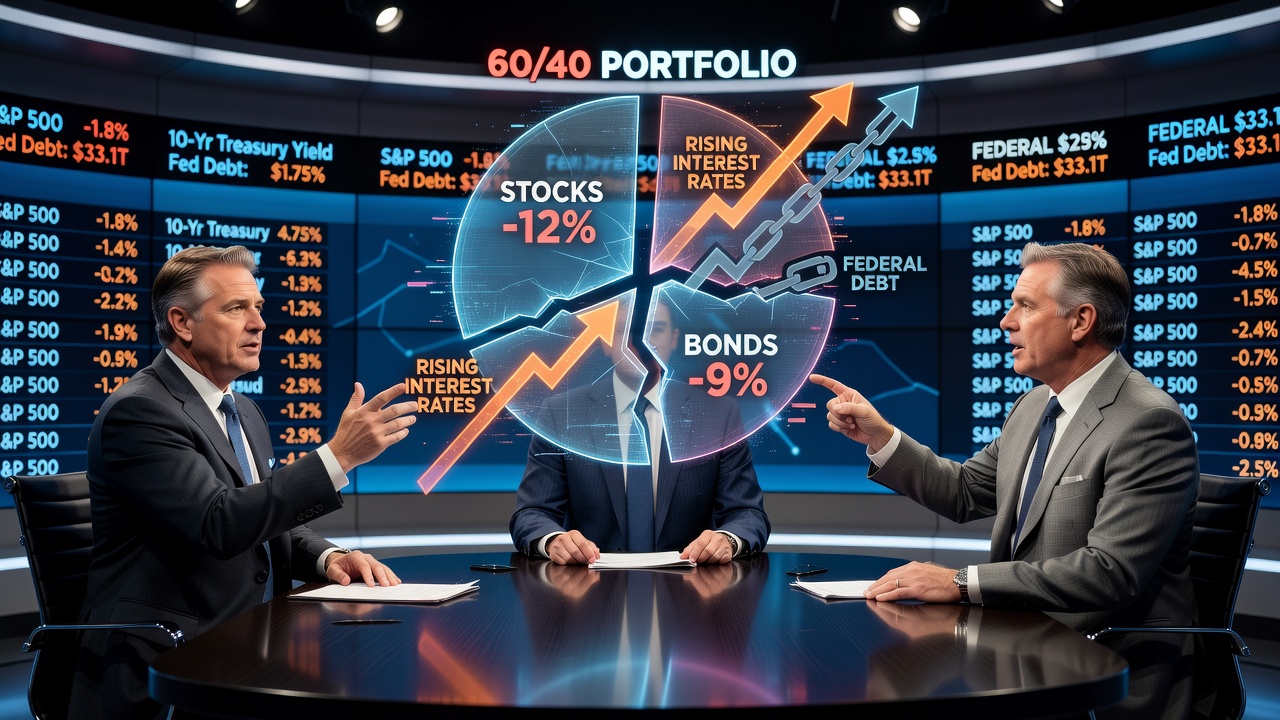
A portfolio strategy that generations of financial advisors treated as a reliable default is facing fresh scrutiny. In a recent conversation on Yahoo Finance's Trader Talk, David Miller, Chief Investment Officer at Catalyst Funds, and Chad Morganlander, Senior Portfolio Manager at Washington Crossing Advisors, examined whether the classic 60/40 split between stocks and bonds still holds up when interest rates climb and federal debt continues to expand. Their exchange, moderated by host Kenny Polcari, surfaced a debate that matters well beyond Wall Street trading desks: how ordinary investors should think about risk when two asset classes that normally move in opposite directions start falling together.
The Mechanics Behind a Strained Formula
The 60/40 approach assumes that when stocks decline, bonds typically hold steady or rise, cushioning overall losses. Miller argued that assumption breaks down when rates are rising rather than falling, since bond prices move inversely to yields. Morganlander countered that the model can still function if investors favor higher-quality, lower-volatility equities and build bond portfolios using a laddered structure, where holdings mature on a staggered schedule and get reinvested rather than locked into long-duration debt. Both agreed on a more uncomfortable point: in periods of market stress, correlations between asset classes tend to converge toward one, meaning stocks and bonds decline together, eroding the diversification the strategy depends on.
Age, Risk Tolerance and the Case for Alternatives
A recurring theme was that no single allocation fits every investor. Morganlander was explicit that 60/40 is not designed for someone decades from retirement; it suits investors closer to drawing down assets who need an equity component as an inflation hedge alongside a rolling bond ladder for stability. Miller pushed further, suggesting that more sophisticated investors now have access to tools that didn't exist when traditional allocation models were built: sector-specific ETFs, country-focused funds, and structured products that allow for more precise positioning. He also distinguished between genuine alternatives and assets like real estate or private equity, which he argued don't necessarily perform well when correlations spike, unlike managed futures strategies that follow market trends and have historically gained ground during downturns such as 2008 or 2022.
Complexity Versus Simplicity for Retail Investors
Both guests cautioned against retail investors over-engineering their own portfolios. Morganlander noted that attempts to optimize returns as an individual, without institutional resources, often introduce more risk than they remove. His preferred approach for bond exposure is holding individual bonds directly and laddering maturities, rather than relying solely on bond funds, calling it a simpler and less stressful method. Miller acknowledged that managed futures strategies are difficult for individuals to replicate on their own, since they involve futures contracts, but noted that mutual funds or ETFs built around those strategies can offer diversification without requiring direct trading experience.
The Debt and Rate Backdrop Driving the Debate
The conversation also turned to the macroeconomic pressures reshaping fixed-income markets. Both guests pointed to the scale of federal debt and the annual deficit as structural forces likely to keep upward pressure on rates unless economic growth significantly outpaces inflation. They noted that credit spreads remain historically tight even as global government borrowing increases, a combination that can mask underlying risk until market conditions shift. The broader implication for everyday investors is that interest-rate direction, not just stock market performance, is now a central variable in portfolio construction, and strategies built for a falling-rate environment may need real reassessment rather than minor adjustment.